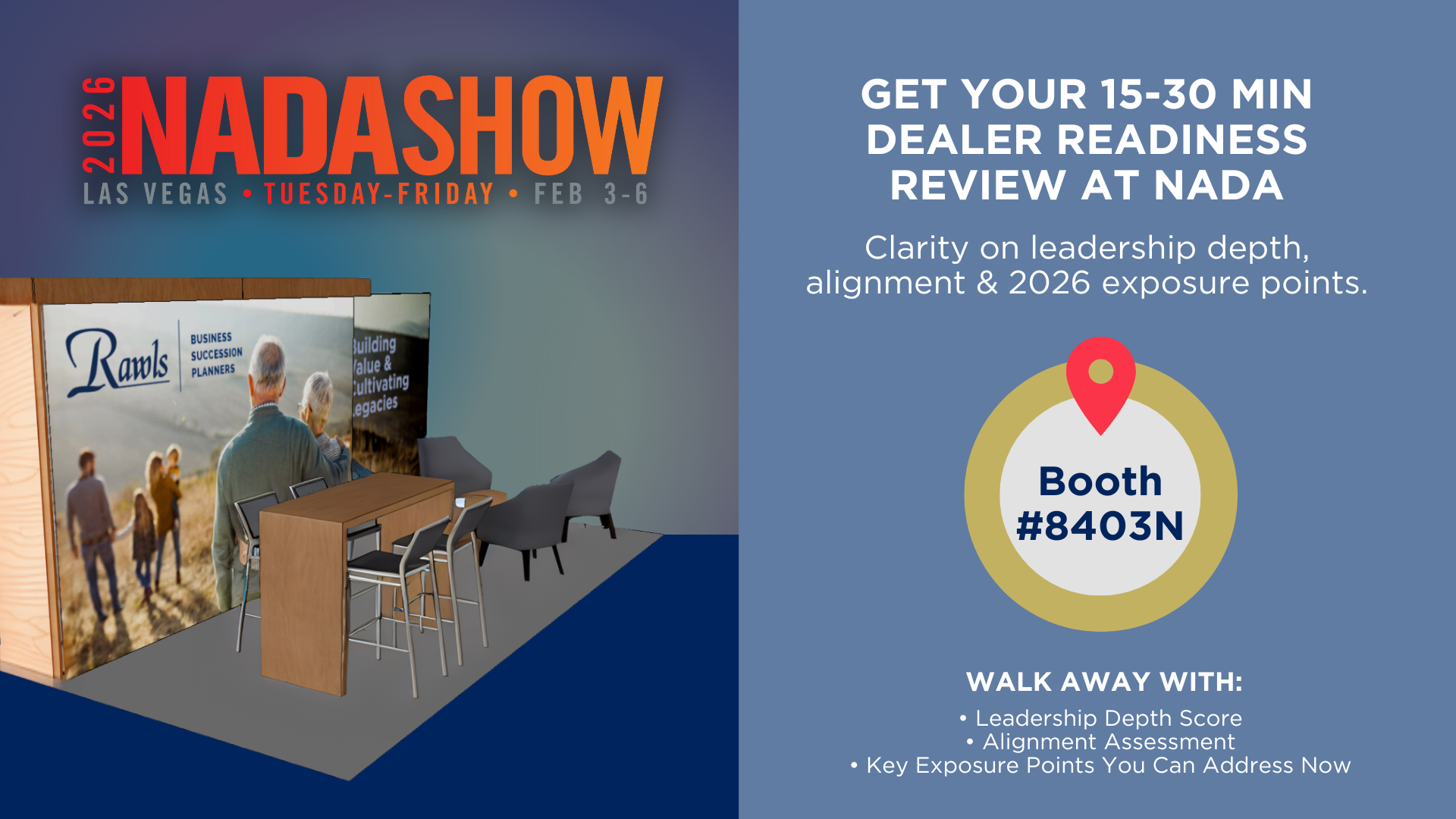
2026 dealer strategy depends on more than interest rates and consumer strength—it requires organizational alignment. Interest rates are projected to fall and the consumer remains resilient, yet margins are tight, deals are harder to close, and internal friction is rising. For dealer groups looking ahead to 2026, the real disruptor isn’t the economy—it’s the gaps inside leadership readiness, decision-making clarity, and organizational alignment.
This isn’t the time to guess. It’s time to assess.
Quick Summary: 2026 Dealer Strategy
The automotive retail landscape is shifting fast. This is the 2026 dealer strategy groups are using right now to stay ahead financially, strategically, and organizationally. Learn why leadership alignment, decision clarity, and continuity—not prediction—are what allow dealer groups to turn market complexity into opportunity.
The Market is Complex. That’s Not the Problem
In the video featuring Dan Gavin and Todd Buechs of AllianceBernstein Private Wealth Management and Kendall Rawls of Rawls Succession Planners, one insight hits hard: The real threat isn’t the market, it’s whether your leadership structure and decision-making are strong enough to respond.
▶ Watch the full 2026 Dealer Outlook conversation above to hear how AllianceBernstein is reading interest rates, tariffs, ICE vs. EV, and the affluent buyer.
As we approach 2026, there’s no single disruptor. Instead, dealers are facing a collision of forces:
- Interest rates and Fed policy uncertainty
- Tightening margins and normalization
- Consumer affordability pressures
- Electrification uncertainty and tariff risk
- Ongoing consolidation and OEM unpredictability
Individually, any of these factors is manageable. But combined? They expose gaps in leadership, alignment, and strategy.
AB’s 2026 Outlook: Tariffs, Credit, ICE, and the Wealthy Buyer
According to Dan Gavin and Todd Buechs of AllianceBernstein, here’s what dealers can expect from the economic and consumer environment:
- Interest rates: 3–4 rate cuts forecast for 2026
- Tariffs: Favorable for U.S. OEMs with local manufacturing
- EVs vs. ICE: Internal combustion and hybrids are gaining ground as EV demand stalls
- Consumer strength: Delinquencies are up slightly, but credit normalization is underway
- Affluent buyer base: The average new car buyer earns $115K+ — a stable, bankable audience
Dealers operating in high-income markets may experience increased price sensitivity, but consumer fundamentals remain structurally sound.
Before committing to 2026 growth, capital, or transition decisions, many dealer principals step back to assess whether leadership depth, alignment, and continuity are strong enough to execute under pressure. Market conditions matter — but readiness determines outcomes.
Many dealer principals use the weeks leading into NADA as a natural checkpoint for this assessment.
To get a fast, objective snapshot of readiness, many dealer groups complete the Dealer Growth & Continuity Scorecard or schedule a Dealer Readiness Review.
Financial Independence is the Real Advantage
As Kendall Rawls emphasizes in the video, the ability to grow your dealership through volatility depends on one thing: Are you financially dependent on the business?
If your lifestyle requires salary, distributions, or personal guarantees, then:
- Delegation feels risky
- You stay trapped in daily decisions
- Strategic planning is always “someday”
Dealers who build wealth outside the business gain flexibility. They can develop next-gen leaders, focus on growth, and pull back without panic.
Is Your Organization Ready for 2026?
Even the best-run stores are feeling the pressure. Margins are tighter, every deal takes more effort, and internal cracks are showing:
- Are your GMs, CFOs, and department heads aligned?
- Do you have a bench of leaders ready for growth or exit?
- Is decision-making consistent and fast across the dealership?
This is the heart of automotive succession planning for multi-rooftop dealer groups: aligning leadership, decision authority, and structure so the business can perform through any 2026 scenario.
Dealers headed into 2026 with confidence are tightening their playbook. They’re using tools like:
- The Succession Matrix® to evaluate gaps across 10 interdependent areas
- Dealer Growth & Continuity Scorecard to assess leadership, structure, and strategy alignment
- Ownership planning to reduce personal risk and improve transferability
- Leadership development to create real bench strength, not just warm bodies
- Hidden Leadership Crisis in Dealerships: Discover the structural red flags that are silently weakening your organization—and how top dealers are fixing them before it’s too late.
- Family in the Dealership: Clarity, Alignment & Strategy for 2026: See how top dealer groups are transforming family involvement into a competitive advantage by strengthening alignment across owners, next-gen, and key managers.
- Why Dealership Valuation Risk Impacts OEM Approval, Financing, and Succession: What buyers, lenders, and OEMs are really watching. A practical look at how leadership structure and alignment are driving dealership valuation risk heading into 2026.
FAQ: 2026 Dealer Strategy
What is a 2026 dealer strategy?
A 2026 dealer strategy is a coordinated plan that aligns leadership, decision-making, and organizational structure so a dealership or dealer group can perform through tighter margins, normalization, consolidation, and succession pressure. Unlike past cycles, 2026 dealer strategy is less about predicting the market and more about ensuring the organization can execute under complexity.
Why is leadership alignment so important for dealer groups heading into 2026?
Leadership alignment is critical for dealer groups heading into 2026 because margin pressure, capital constraints, and manufacturer expectations expose internal gaps quickly. When owners, GMs, controllers, and department leaders are misaligned, decisions slow, accountability blurs, and execution suffers—regardless of market conditions.
What does “dealer readiness” actually mean?
Dealer readiness refers to whether a dealership or dealer group has the leadership depth, clarity of authority, and continuity structure needed to execute strategy without overreliance on one or two people. A ready organization can grow, transition leadership, and respond to pressure without destabilizing operations.
How do dealer groups assess leadership readiness and continuity risk?
Dealer groups assess leadership readiness and continuity risk by evaluating decision authority, leadership bench strength, succession exposure, and alignment across owners and key managers. Tools like the Dealer Growth & Continuity Scorecard provide a fast, objective snapshot of where gaps exist before pressure forces action.
What is the Dealer Growth & Continuity Scorecard?
The Dealer Growth & Continuity Scorecard is a 3–5 minute diagnostic designed specifically for dealer groups to benchmark leadership depth, alignment, and continuity risk. It highlights where organizational structure, succession readiness, and decision-making clarity may be limiting performance heading into 2026.
Is a dealer strategy or a dealer succession plan only for dealers planning to exit?
No. A 2026 dealer strategy or a dealer succession plan is not just for dealers planning an exit. Many dealer principals use this work to prepare for acquisitions, strengthen leadership teams, improve bankability, develop successors, and reduce personal dependence on the business—regardless of timing.
Why do strong market conditions still feel heavy inside many dealerships?
Strong market conditions can still feel heavy inside many dealerships because internal alignment, leadership structure, and decision-making clarity are often weaker than the market itself. Even when interest rates stabilize and consumer demand remains resilient, unclear roles, decision bottlenecks, and leadership gaps create internal friction that slows execution and increases strain across the dealership.
How does financial independence affect dealer decision-making?
Financial independence affects dealer decision-making by giving dealer principals flexibility and control over long-term strategy. When a dealer’s personal lifestyle is not dependent on salary, distributions, or personal guarantees from the business, decisions can be made based on growth, leadership development, and continuity rather than short-term pressure or risk avoidance.
Do I need to attend NADA to benefit from this dealer readiness and succession planning strategy?
No. You do not need to attend NADA to benefit from this dealer readiness and succession planning strategy. While many dealer principals use NADA as a natural planning checkpoint, the Dealer Growth & Continuity Scorecard and Dealer Readiness Review are available before and after the conference. These tools help dealer groups assess leadership readiness, alignment, and continuity regardless of conference attendance.
What happens after I complete the Dealer Growth and Continuity Scorecard?
After you complete the Dealer Growth & Continuity Scorecard, you receive an objective snapshot of leadership strength, alignment, and continuity risk across your dealership or dealer group. Many dealers then choose to schedule a Dealer Readiness Review to interpret the results, identify priority gaps, and clarify next steps related to leadership structure, succession readiness, and strategic focus—without sales pressure.