On the surface, your store is running fine. Margins are healthy. Culture is decent. Managers are loyal. But if you’ve got family in the business, and things feel heavier than they used to—you’re not imagining it.
When family involvement isn’t clear, aligned, and structured, decision-making slows, priorities get fuzzy, and tension builds quietly behind the scenes.
Heading into 2026, that’s no small risk.
Quick Summary: Family in the Dealership
Family involvement in a dealership can be a powerful strategic advantage—or a silent performance risk. Heading into 2026, the difference isn’t family itself. It’s whether roles, authority, and expectations are clearly structured and aligned across owners, key managers, and next-generation family members.
Top dealer groups are addressing this now by:
- Clarifying roles, timelines, and decision authority across family and non-family leaders
- Reducing friction through behavioral assessments and communication tools
- Installing governance and Management Advisory Boards (MABs) to stabilize decision-making
- Creating structured next-gen development paths without politics or assumptions
What Happens Without Alignment?
When there’s family in the business, but no structure behind it, here’s what starts to show up:
- Decisions slow down
- Managers hesitate
- Priorities shift based on emotion, not strategy
- Conflict avoidance overrides accountability
Non-family leaders pull back - Next-gen leaders either stall—or move too fast, without the foundation to support them
This is how family involvement becomes a performance drag—not because of intent, but because leadership structure hasn’t kept pace with complexity.
That misalignment is the the hidden cost in automotive succession planning for dealer groups.
Watch the full Family in the Dealership discussion above, with Anmol Kohal, for real-world insight and strategies dealers are using now
6 Family Friction Patterns Dealers Miss
If any of these sound familiar, you’re not alone:
- Family members unclear on roles, expectations, or timelines
- Parents unsure how much space or pressure to give
- Siblings with different skill levels or interest in the business
- Non-family leaders stuck in the middle
- Managers don’t know how to “treat family fairly”
- Owners stuck between protecting relationships and driving performance
None of these are character issues. They’re structure issues.
And without clarity, they only get louder.
How Misalignment Hurts Dealer Performance
Misalignment doesn’t start with blowups. It starts with silence.
- Conversations get careful
- Conflict goes underground
- Execution slows
- Energy shifts from momentum to maintenance
- High-performers hesitate or burn out
And it all gets amplified when your family is part of the operating structure.
What Strong Dealers Are Doing Now
They’re not waiting for succession “someday.” They’re aligning now, across roles, timelines, decision authority, and development plans. Real structure, not vague plans.
2. Using Behavioral & Communication Assessments
They use tools like PDP ProScan® to decode communication styles across family and non-family leaders. That means fewer misunderstandings and stronger collaboration.
3 Implementing Management Advisory Boards (MABs)
A MAB gives the dealer, GM, and key managers a structured, neutral environment to align on strategy and execution, without drama.
4. Creating Structured Next-Gen Development Plans
They’re using frameworks like BASKE (Behaviors, Attitudes, Skills, Knowledge, Experience) to evaluate readiness and build a clear path for future leadership.
5. Establishing Real Governance
Not just a corporate board, but dealership-appropriate governance with clear rhythms, mapped decision rights, and conflict mediation tools.
6. Strengthening Family + Key Leader Alignment
They’re prioritizing relationships between family members and non-family executives—with shared vision tools, conflict prevention, and alignment around expectations.
- Hidden Leadership Crisis in Dealerships: Discover the structural red flags that are silently weakening your organization—and how top dealers are fixing them before it’s too late.
- 2026 Dealership Strategy: What Strong Dealer Groups Are Doing Now: Learn how top-performing groups are preparing for margin pressure, OEM demands, and internal misalignment going into 2026.
- Why Dealership Valuation Risk Impacts OEM Approval, Financing, and Succession: What buyers, lenders, and OEMs are really watching. A practical look at how leadership structure and alignment are driving dealership valuation risk heading into 2026.
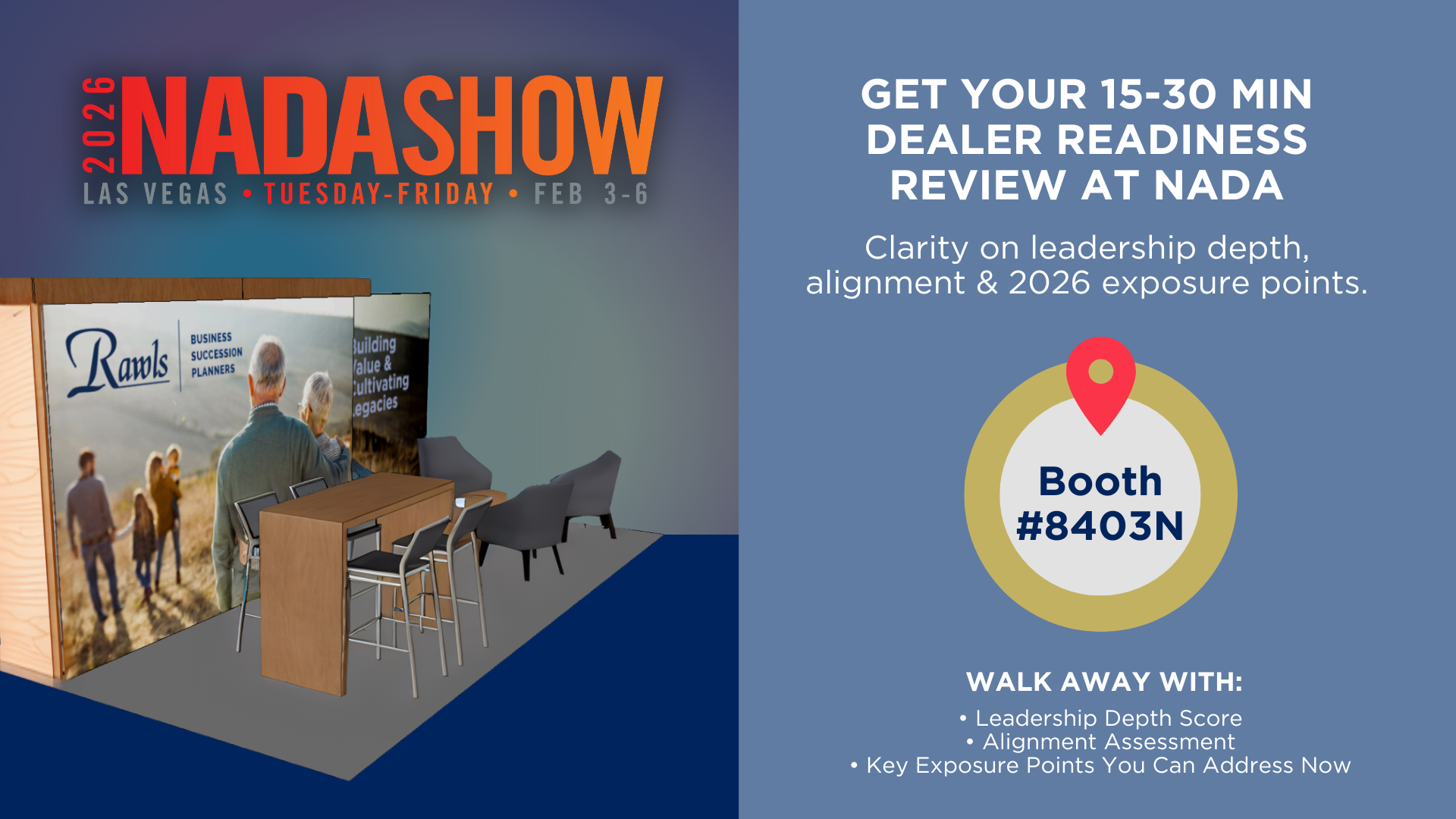
Many dealer principals use the period leading into NADA as a moment to reset expectations, clarify roles, and assess readiness across family and leadership.
View NADA 2026 Dealer Readiness Resources →
FAQ: Family in the Dealership
What’s the biggest risk of having family in the dealership?
The biggest risk of having family in the dealership is unclear expectations and decision authority. When family roles, timelines, and accountability aren’t clearly defined, decision-making slows, managers hesitate, and performance suffers—even when relationships are strong.
Isn’t succession planning just about who takes over someday?
No. Succession planning for family dealerships is not just about who takes over someday. Modern automotive succession planning focuses on leadership structure, decision clarity, and alignment right now—so the dealership can perform, grow, and transition leadership without disruption.
How does family involvement impact succession planning in dealerships?
Family involvement impacts succession planning in dealerships by influencing leadership alignment, decision authority, and continuity risk. When family expectations and roles are not structured, succession planning stalls and tension increases. When family involvement is clearly aligned, it becomes a stabilizing force that strengthens leadership and long-term performance.
What does “dealer readiness” mean for family-owned dealerships?
Dealer readiness for family-owned dealerships means having the leadership depth, governance structure, and clarity of roles needed to operate without overreliance on one or two individuals. A ready dealership can handle growth, leadership transitions, and family dynamics without slowing execution.
How do dealer groups evaluate family alignment and leadership readiness?
Dealer groups evaluate family alignment and leadership readiness by assessing decision authority, leadership depth, succession exposure, and communication patterns across family and non-family leaders. Tools like the Dealer Growth & Continuity Scorecard provide a fast, objective snapshot of where alignment gaps exist.